What is light pollution?
Artificial light at night (ALAN) provides value to urban safety, transport, ease of movement, and entertainment- and it is also an emerging threat to biodiversity. ALAN acts on local and larger spatial scales which can be split into two categories: Local ALAN and atmospheric ALAN, or sky glow. Local ALAN is a form of point-source pollution; direct illumination from a streetlamp, traffic light, commercial building, etc. Sky glow is the accumulation of all misdirected light, reflected back down from the atmosphere.

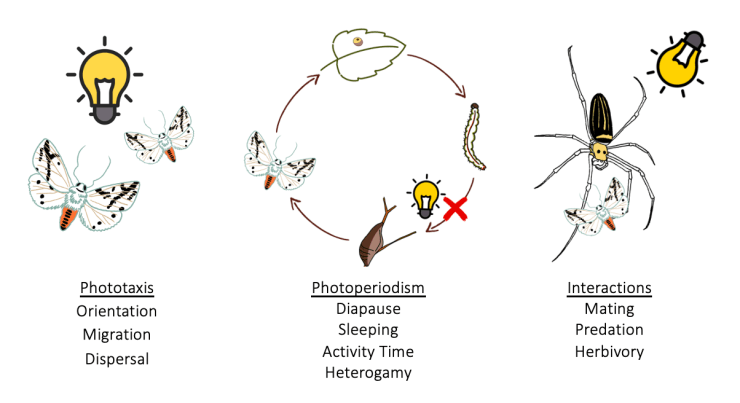
To nocturnal creatures, intrusive light in the nighttime niche poses a considerable threat. ALAN is one of the suspects behind global insect declines- a reasonable link considering more than 60% of all insects are nocturnal during at least one life stage. ALAN disrupts circadian entrained biological processes. In insects, these include phototaxis (attraction to light) and photoperiodism (the timing of life activity based on light cues). ALAN can also change the dynamics of intra and interspecific species interactions: notably, there have been observations of diurnal predators and parasitoids shifting to nocturnal activity under ALAN.
We still don’t have vital information about this growing threat to biodiversity
- Insect decline literature often makes global claims while relying on temperate data.
- Present ALAN research is conducted primarily in temperate regions, which may not be generalizable to tropical systems.
- ALAN’s relationship to habitat loss via urbanization make it difficult to untangle direct contributions to insect declines.
- Traditional nocturnal insect surveys rely on artificial-light traps as a collection method, but this neglects non-phototaxic insects; a potentially large portion of the overall community in hyper-diverse tropical systems.
The problem: Earth’s most prolific biodiversity hotspots are in the tropical and sub-tropically located countries which are urbanizing the fastest.
Our Study
Hong Kong’s subtropical location and urban design provide an opportunity to answer some of the remaining questions in ALAN research. Hong Kong is characterized by its abundance of natural protected areas (country parks), which create mosaic pockets of tropical forest among the city’s dense urban infrastructure. This allowed us to place our study sites within forests- controlling for land-use while still representing variable levels of sky glow.

All country parks, being designated recreational space, are fitted with street lamps on their hiking paths. This allowed us to include a local ALAN source into our study design as well.
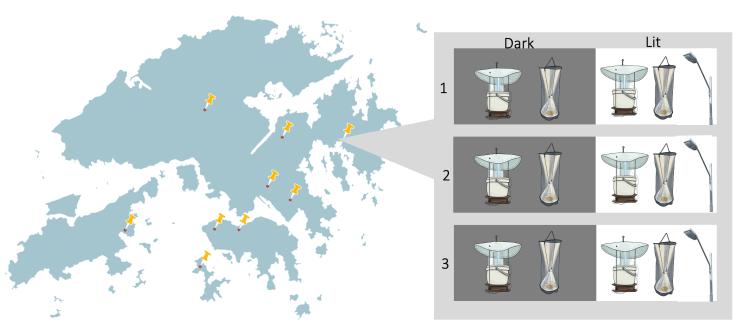
We selected 9 sites across HK to represent low to high levels of sky glow. Each site had three sub-sites with two treatments each: a lit treatment, where traps were placed directly under a streetlamp, and a dark treatment, where traps were placed 10 meter away in a dark area.

By using both light and fruit-bait trap in tandem we were able to capture a more complete picture of the total moth community, which may represent a broader range of species responses to ALAN through the inclusion of non-phototaxic moths.
Hypotheses

The moth community in lit treatments will be different than the moth community in dark treatments

Moth abundance and diversity will be lower in lit treatments than dark treatments

Light traps and bait traps will catch different parts of the moth community
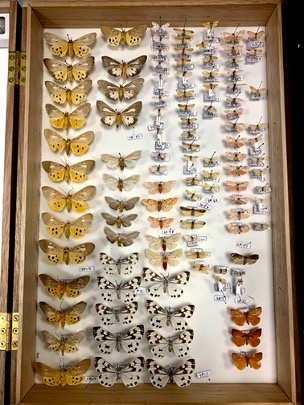
In total, we captured 2,966 moths which we identified to species. Our collection represents 565 moth species, a handful of which are new to Hong Kong or undescribed.
Analysis is currently underway. Stay tuned for updates!
Collaborators:
Woo Sign Yi, Tsz Chun SO, Roger C Kendrick, Tim Bonebrake, Caroline Dingle, and Louise A Ashton
 Victoria E. Amaral